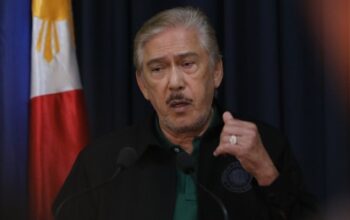


Former Albay Congressman Joey Sarte Salceda has belied allegations he had links with the “insertion” special provision in the 2024 National Budget now blamed as basis of the government’s questionable withdrawal of billions of cash from Government-Owned and -Controlled Corporations (GOCCs), particularly the Philippine Health Insurance Corporation or PhilHealth.
The allegation was aired by retired Supreme Court Associate Justice Antonio Carpio in an interview with journalist Christian Esguerra in his program Facts First Tonight posted on YouTube, referring to a bill Salceda supposedly introduced for the 2024 budget.
In a letter to Esguerra, Salceda said the allegation is “incorrect.” He also wrote a piece in a report of the Institute of Risk and Strategic Studies, Inc., which he chairs, detailing the facts on the issue.
“First, I was never a member of the Appropriations Committee, the bicam or the small committee in the 19th Congress. An ‘insertion’ by me is procedurally impossible,” he emphasized.
“Second, the idea that the 2024 provision was “lifted” from my bill simply does not stand. My bill never became law. It sought to amend the 2023 budget and allowed GOCC excess funds to be tapped only if they were unencumbered by benefit obligations. Under that rule, PhilHealth could not remit anything if it had legal liabilities to fund,” he added.
Salceda said the “2024 provision was completely different. It mandated GOCCs to reduce their reserves to “historical levels” and imposed deadlines for submission — effectively compelling the release of any free cash on hand. That is why it ran into constitutional issues, especially for GOCCs whose charters protect their reserve funds.”
I introduced House Bill No. 9513 to fund 2023 (not 2024) the COVID 19 borrowings, which was passed by the House of representatives but did not become law,” he said.
“As the Government committed to a “no new taxes” pledge, the proposal was prodded by the need to look for money where it is legally and regulatorily possible to fund the Public Health Emergency Allowance and the Health Facilities Support Fund (both around P52 billion each),” Salceda explained.
“The executive agencies and the House leadership reasoned to me that we needed new source of funds to finance the massive COVID-19 pandemic borrowings, much of which was falling due in 2023,” he said. The bill was approved in the House of Representatives but did not become law.
“Any connection between me and that idea ended there. I never filed that bill again or filed any bill for the 2024 budget,” he stressed.
Salceda said the idea comes from an even earlier Bayanihan bill during the pandemic to “disgorge” the equity of GOCCs with excess funds. That also did not become law. Now, whether the budget committees copy that bill to fund the 2024 budget is entirely up to their discretion. “It is customary for other members of Congress to copy from my bills,” he added.
“The bill also entirely left the discretion and determination of defining what is “excess” and which corporations should remit funds, to the Executive Branch as a flexibility. Again, my own bill DID NOT become law,” he further explained.
The bill furthermore did not amend the charters of GOCCs like Philhealth to enable them to remit excess funds. If their charters prevented them from doing any transfer, then they cannot be forced to make any transfer, said Salceda.